- Our read: long-term interest rates fell this week, and not for a good reason. Inflation didn't cool, and the long end's fall had no softer Fed priced into it; that showed up only at the short end, on Friday, after the chair spoke. Money ran for cover into government bonds, and the fear behind it was aimed at AI and chips, not at the whole market
- Retirement core: no action. The S&P 500 sits about 2% under its record close, and our rule only looks at month ends. Next check Friday 30th October
- The one number: about seven in ten S&P 500 stocks rose in a week the index fell about 2%, 350 of its 503
- The one date: Wednesday 28th October, the Fed's decision. Its officials went quiet on Saturday 17th October and nothing is scheduled from them before then
- Also inside: a rotation, not a rout; why the easy money in AI is done; how a headline (KFC drops Pepsi) becomes a decision; and last issue's checks, scored
The Weekrates fell for the wrong reason
The week started too quiet and ended nervous. On Monday the bond market had the day off for Columbus Day and the S&P 500 barely moved, as if the whole market had gone to the shops with it. By Friday stocks were down, the fear gauge was up, oil was up and Treasuries, US government bonds, had a proper bid under them, meaning buyers queuing: a risk-off line-up, though the money stepping out was stepping out of AI and chips, not out of everything. Our stance hasn't moved an inch: the retirement core does nothing.
The macro first. Last issue we said we'd open this one on what September's inflation number did to the ten-year. Here it is, and it isn't what anyone drew on the whiteboard.
On Wednesday 14th October the core inflation print, the reported number, prices with food and energy taken out, came in a tenth hotter than forecast, 0.3% for the month against 0.2%. The kneejerk, the reflex before anyone has had a think, was straight out of the textbook: within about half an hour the two-year Treasury yield, the end of the market that lives and dies by the Fed, had jumped by about two-thirds of a quarter-point hike, and by the close most of it was gone. The ten-year jumped about 0.14 and was back where it started by the bell. Thursday's producer prices, what businesses receive for what they sell, rose 1.3% in September, more than double the forecast and the biggest monthly rise since early 2022. Oil rose about 5% on the week, with Brent at about $110. All of it the sort of thing that pushes long-term rates up, and yet over the week the ten-year fell about 0.15, to about 5.1%. The thirty-year fell a bit more. Despite the two hot prints, mind, not on them: the long end barely moved on Thursday's and did most of its falling overnight into Thursday.
The consensus take, the story everyone tells each other, was out within the hour: yields fell, so that's relief, so that's good for stocks, everyone breathe out. Our read is that they fell for the wrong reason, and why matters far more than how far. Yields fall for a good reason when inflation cools and nearly everything rallies at once; Thursday 10th November 2022 was that day, inflation under forecast and the S&P 500's best day since April 2020. Or they fall for a bad one, fear: a flight to quality, money bolting for the safest thing it can find, here government bonds. Not much of a contest this week, if one looks under the hood. Expected inflation, the gap the bond market prices daily between a normal Treasury yield and an inflation-protected one, edged up a few hundredths; a good-reason week needs it to fall. The Fed path the market expects, on the New York Fed's model, was flat: nobody had a kinder Fed priced in, desk talk for already in the price. And on that same model the whole of the fall to Thursday sat in the term premium, the extra pay lenders demand for lending ten years rather than a few months. They took less of it, and the reading that fits is that they wanted the safety more than the pay. One caveat, so nobody writes in: that split is a model, not a thermometer, and its last day is Thursday.
Now the awkward bit. Last Sunday we said the long end was lagging because lenders wanted more pay for lending long, and that only oil could turn it into an inflation story. Oil duly rose and expected inflation still barely moved, so that half held. The premium we built the whole title on, though, came back down, below the level we named as the check that would prove us wrong. So it fired, the very next week. Hands up: that one came unstuck. Also from the tidy-up: a month ago the ten-year followed oil day to day like a dog on a lead; in October it simply stopped.
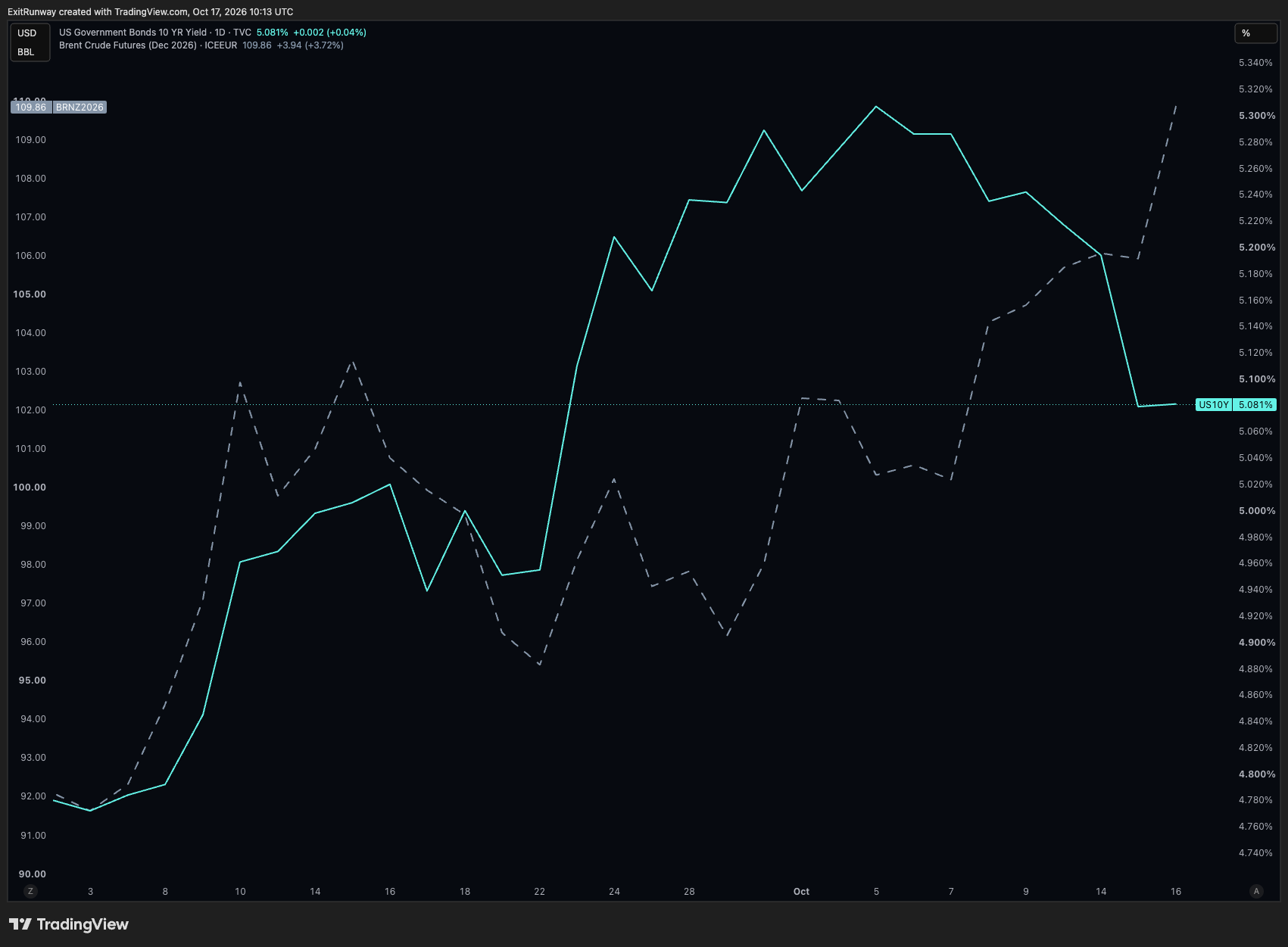
The other side, honestly, because nothing about this is black and white. It's fear, yes, but small and aimed. The junk spread, what riskier companies pay to borrow over the US government, rose about a tenth of a point to Thursday and on Wednesday hit its widest since March; still under March's high, mind. The investment-grade spread, for solid companies, didn't move. The dollar slipped, though a run for safety usually lifts it, and gold slipped too despite falling real yields, the ones with inflation taken out, which normally help it. Neither is what a broad panic looks like. Nor need all the bond buying be fear: some may be short covering, traders who bet against Treasuries buying back once offside, on the wrong side of the move, and that was one of the most crowded trades going into the week, crowded meaning everyone holds it and the exit is narrow. And about seven in ten S&P 500 stocks rose (section 2). So the fear sat in one corner of the room, AI, chips and the companies borrowing heavily to build data centres, and everybody else carried on with their drinks. There's a sting in that, though: a lower long rate helps a borrower and a share price whatever the reason, and never asks why. If the pain the bond market is bracing for never shows up, the market pockets the good reason's reward without ever having had the good reason. A condition, not a forecast, and a big one.
What does this mean? For the retirement core, nothing: the S&P 500 is about 2% under its record close, and our rule never acts on a bond yield, however exciting the bond yield gets. For stocks, the index fell about 2%. The chip index fell about 11%, to about a quarter below its June record. Yet most stocks rose, so breadth, how many stocks join a move, was positive in a down week: the selling had an address. Two ways from here: the fear stays inside AI and a lower long rate helps everything else catch up, or it spreads and the safe havens fall too, the defensive names money rotated into this week, rotation being money leaving one group of stocks for another. For commodities, Friday's jump in oil came on several things at once: Iranian attacks in the Strait of Hormuz, Houthi missiles at Saudi Arabia, and Ukraine vowing to hit Russian refineries. For borrowers, the US government now pays a touch less for ten years. A thirty-year mortgage is still about 7.4% on the latest reading, taken before most of the week's fall, so next Thursday's is the first reading that can show whether relief reaches the kitchen table. And junk-rated companies, the borrowers who needed it most, got none: their all-in cost of borrowing was flat on the week while the government's fell. Not a penny.
So the swing factor this week is not oil, it's the junk spread, and credit spreads are the be all and end all right now. It tells you which kind of fall you're in: narrowing as stocks rise fits relief; a big, lasting widening fits fear, and that's the double whammy for the spicy stuff, the riskier names, because then the lower rate doesn't help them either. Right now it's small and a few days old: a read, not a verdict. Oil is second, because another spike makes it fear and inflation at once, the one combination with no good answer. Both head WHAT WOULD CHANGE OUR MIND.
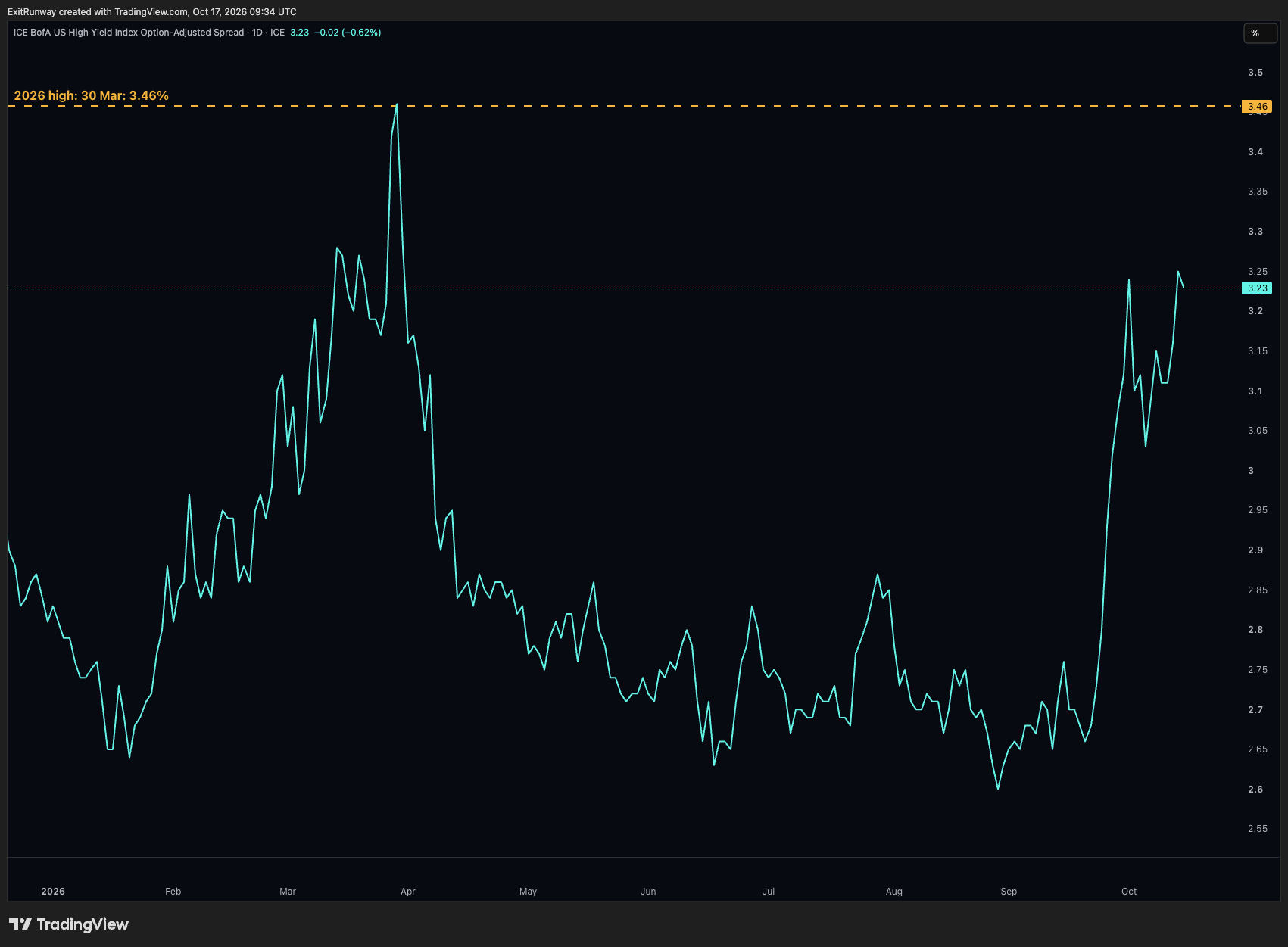
The extra yield a riskier company pays over the US government to borrow for the same length of time. The one we quote most is the junk spread, for companies rated below investment grade. It widens when lenders start to worry about being paid back, and it narrows when they stop. It is the market's own solvency check, and it does not care what the company says on CNBC.
The week's data points, each with a verdict. Core inflation and producer prices, both hot: the first moved our checks, and the long end had shrugged both off by the close, which rather proves the point. The Fed chair, Kevin Warsh, spoke in Bangkok and gave nothing away, "I don't prejudge meetings" being the sum of it, and by Friday's close the market put a hike this month at about one in six. The VIX, the market's vol gauge, built from S&P 500 options prices, the fear gauge, rose about a third to about 20: nervous, not frightened. Friday's fall had several drivers and no single headline. Death by a thousand cuts is our reading, and the cuts have been coming all week.
The week ahead, in US Eastern time, a light one for once.
| Day | What | Why it matters |
|---|---|---|
| Sat 17th Oct | The Fed's quiet period began | No policy talk from its officials until after the meeting |
| Tue 20th Oct | Housing starts and permits (8:30). Netflix results after the close | A read on how a 7.4% mortgage is landing |
| Wed 21st Oct | 20-year Treasury auction. Tesla results after the close | A test of the bid for long-dated government debt in a risk-off week |
| Thu 22nd Oct | 5-year TIPS auction. Weekly jobless claims (8:30) | TIPS are inflation-protected bonds: a fresh read on expected inflation |
| Fri 23rd Oct | No major US data |
No inflation number or monthly jobs report this week, only the weekly claims, so the bond market has mostly itself to talk to.
Further ahead.
| Day | What | Why it matters |
|---|---|---|
| Tue 27th-Wed 28th Oct | Fed meeting | A hike priced at about one in six at Friday's close |
| Thu 29th Oct | Q3 GDP, first estimate, and September PCE, the Fed's preferred inflation gauge (8:30). Intel results | The first full read on growth and prices before the month end |
| Fri 30th Oct | The October close | The retirement check |
So the Fed is silent until its decision on Wednesday 28th October, and the bond market has to make its mind up unaided. Anyone who tells you which way it breaks is kidding themselves. We'll watch the two things that will tell us: the junk spread, wider or narrower by then, and oil in the meantime. Quite frankly, the quiet weeks are the ones worth watching closest.
Your Moneya rotation, not a rout
Most of America's biggest companies went up this week; it was the index that fell. The S&P 500 dropped about 2% while about seven in ten of the stocks in it rose, 350 of the 503, the typical one by about 2.5%. That is a rotation, money leaving one group of companies for another, not a rout, and the difference matters more to your retirement money than the index level does. It is also the macro seen from the other side: the fear that pulled money into Treasuries came out of one corner of the stock market, and the rest of the big companies quietly got on with it.
How do you tell the two apart? A rout sells everything, the safe names included, and Monday 16th March 2020 is the textbook page.
| Monday 16th March 2020, a rout | This week, a rotation | |
|---|---|---|
| Sectors that rose | None of the 11 | 7 of the 11 |
| Consumer staples (the soap-and-cereal names that are meant to hold up) | about -7% | about +5% |
| What rose | Long-dated Treasuries, nothing else | Staples and energy about 5%, health care about 3.5% |
| What fell hardest | Everything: Coca-Cola -6.6%, Johnson & Johnson -5.3%, Procter & Gamble -4.9% | Tech nearly -8%; AI hardware such as Ciena, Coherent and Dell down about a quarter |
When the sellers have a shopping list that specific, it isn't panic. It's a change of mind about one trade.
So why did the index fall at all, if most of its stocks rose? Because the S&P 500 is weighted by size, and its ten biggest companies are about 40% of it. Those ten gave about four-fifths of the week's fall, and seven of them are chip makers or the big AI spenders. The equal-weighted S&P, the same 500-odd companies with every one counting the same, beat the normal index by about 2.5 points on the week. Same companies, different weights, opposite story.
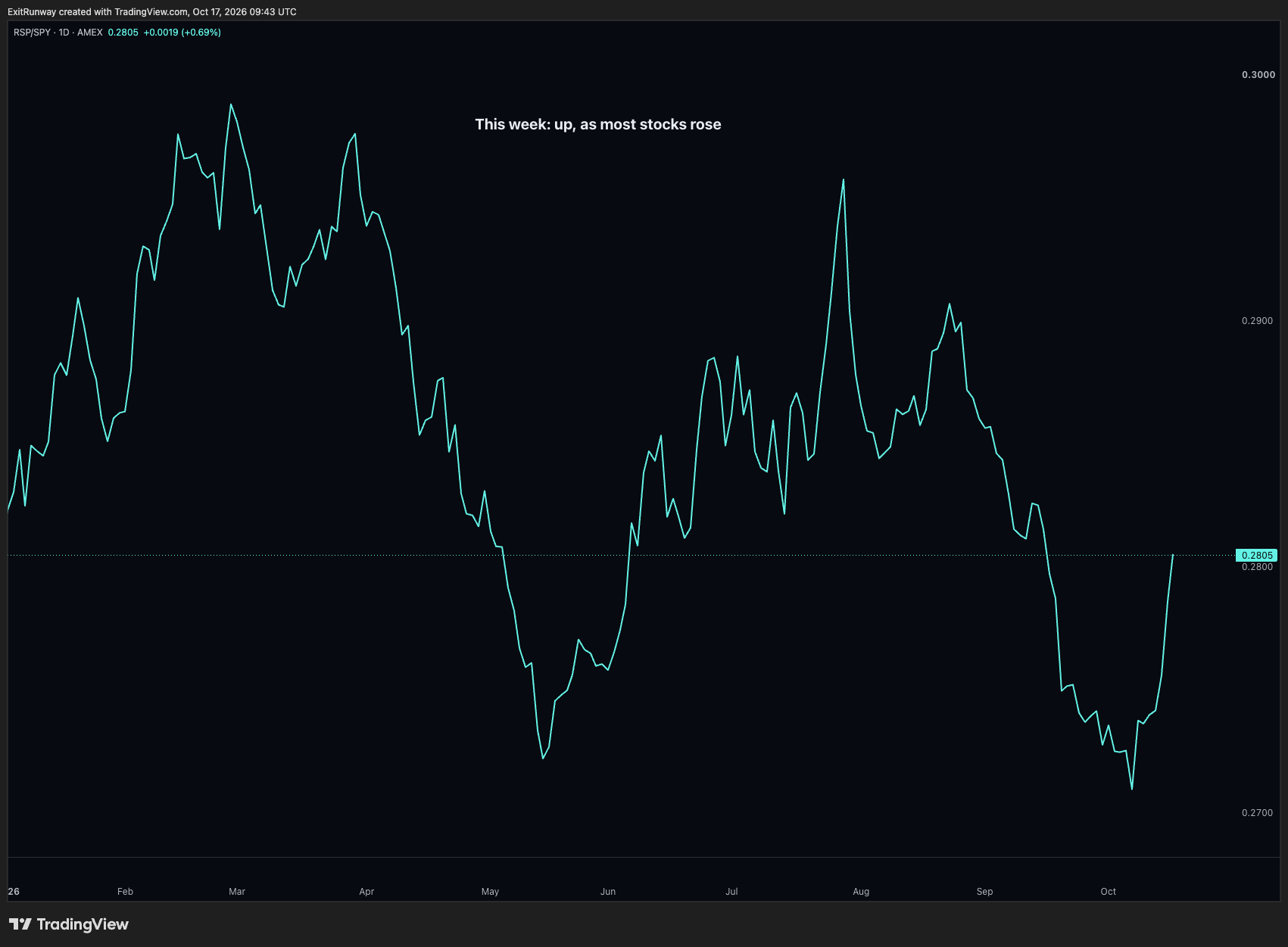
The longer window, honestly, because for two months it ran the other way. From mid-August to this Thursday the S&P 500 was about flat. The equal-weighted version lost about 3.5% over the same stretch. Small caps lost about 10%. The giants were masking the rest, not the other way round. And about a third of S&P 500 stocks are still 20% or more below their high, bear-market territory by the usual yardstick, while the index sits about 2% off a record. This week undid a little of that. A little, not all of it.
What made the turn so sharp was who was standing where when it came. Fund managers went into the week the most overweight tech, holding more of it than their benchmark, since August 2020, and speculators' bets on the Nasdaq-100 hit a nine-year high on Tuesday 6th October before being cut back. A crowded trade with a narrow exit, as section 1 said of the bond market; the stock market had the same door.
The banks, briefly, because they reported this week. JPMorgan rose about 2% on the week, the best of the six big banks, while the index of big banks fell for a sixth straight week. On results day it slipped, but by less than the bank index. Good numbers that set it apart from the pack, and that's the whole story; we'll resist reading tea leaves in it.
What does this mean for your money? If you own an S&P 500 index fund, you own the AI trade whether you like it or not: two in every five dollars of it sit in ten names, most of them in that corner. Not a verdict on the fund, just something to know you own. The retirement core does nothing, because a wild week in the chips is the trading book's business, not the retirement money's, and our rule only reads a month-end close. The day the safe names start falling with AI is the day this stops being a rotation, and that day is a check in section 5.
The S&P 500 sits about 2% under its record close. Our rule reads only the month-end close, never a week like this one. Next check: Friday 30th October, the October close.
The AI Tradethe easy money is done
Our view, and we'll label it as one: the easy money in AI has been made. From here the question is which names, not whether AI, and this week sorted them in a way worth writing down. The link to the macro is direct. A good part of the build-out, the data centres, chips and power being put up for AI, is built on borrowed money, and in a week when the fear was aimed at AI, the borrowers furthest from the cash fell hardest.
The week itself. The chip index fell about 11% and sits about a quarter below its June record. Thursday had the look of a washout, the desk word for the session where the last sellers get flushed out: the AI names were sold hard in the first three-quarters of an hour, then climbed all day and finished near their highs on heavy volume. That is what exhaustion looks like. It is also what a dead-cat bounce looks like, a short rebound inside a falling market, so nobody should pretend to know which from one session, and Friday answered a little: they fell again, CoreWeave about 12% on the day.
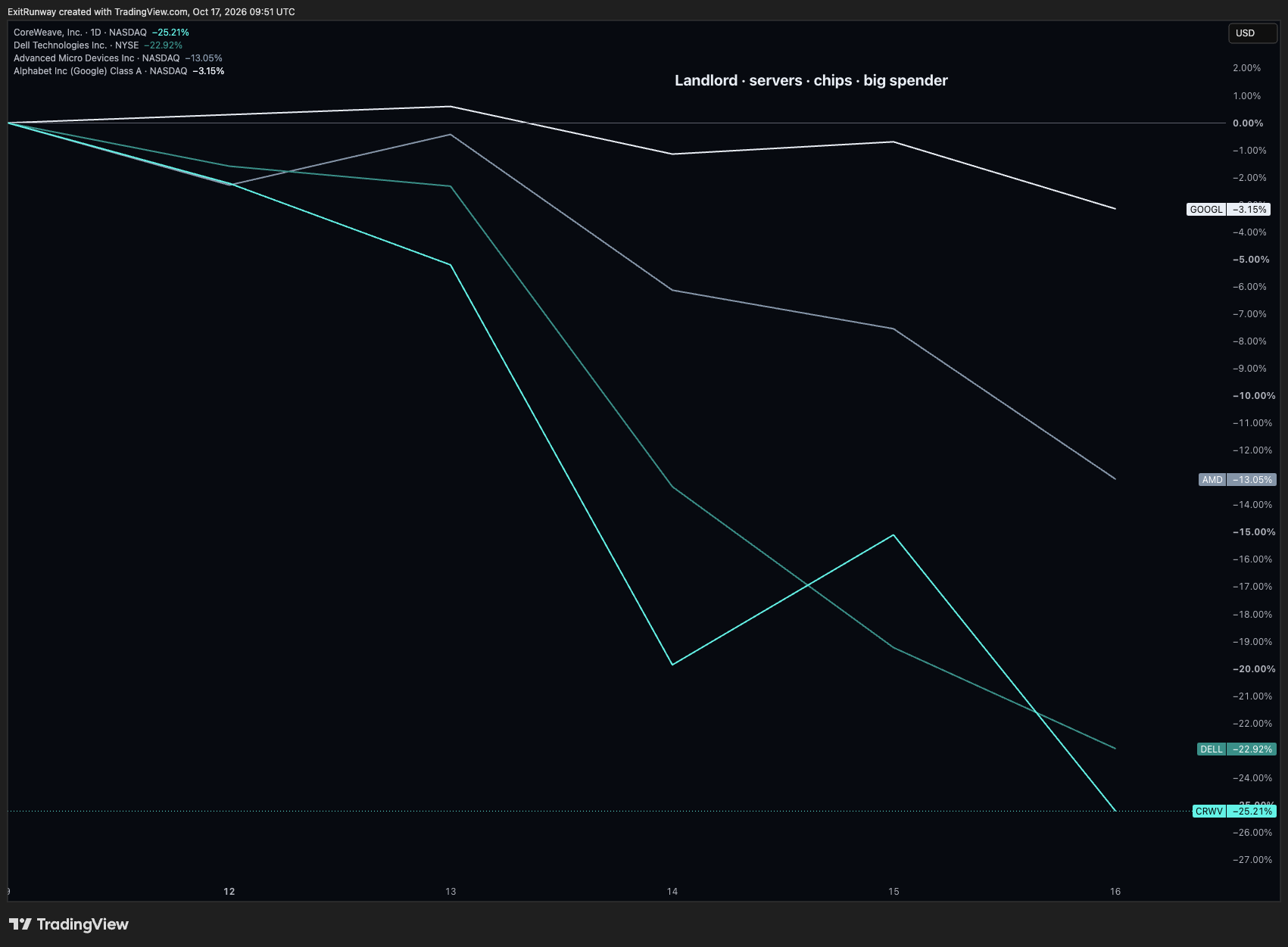
Not every AI stock fell the same, and the sorting is the lesson. We lined up 38 of them and asked what explained the week. What sorted it best was where a company sits in the build-out. Picture a building site: the developer who borrowed to put up the block feels a wobble first, and the tenant with cash in the bank feels it last. So it went.
| Where it sits in the build-out | This week, median | Examples |
|---|---|---|
| The landlords: borrow to build data centres, rent out the chips inside | about -25% | CoreWeave, Nebius about -25% each |
| Server and power makers | nearly -24% | Dell, Super Micro, HPE about -23% to -25% |
| Optics and networking | about -18% | |
| Chip makers | about -13% | |
| Software | about -10% | |
| The four big spenders who pay everyone's bills, the hyperscalers | about -2% |
The further from the cash, the harder the fall. Profit mattered too: the names losing money fell harder than the profitable ones. Debt hurt where it came with losses, CoreWeave and IREN, and not on its own: Oracle, the most indebted profitable name in the group, fell about 9%. And here is the bit that will annoy the value crowd, because it annoyed us. Valuation did not sort this week at all. Micron, among the cheapest at about five times next year's earnings, fell about 15%. Palantir, at over a hundred times, fell about 11%. The cheap, profitable server makers fell about a quarter. One week, so this is this week's evidence and not a law, and over longer windows the price you pay matters a great deal. But anyone who told you "cheap" would protect you this week was over their skis.
The money behind it, because that is the macro link. On Monday 12th October the chief executives of Broadcom and Intel said, at a conference in Singapore, that capital may now be the build-out's main constraint, ahead of chips or power. That was a warning about the industry, not about their own funding, and it was the week to say it. JPMorgan and Goldman, arranging about $5bn for a data-centre project in Norway, reportedly underwrote only the roughly $1.3bn term loan, the plain bank-loan slice, and left the chip-backed part to others, at indicative yields around 11%. CoreWeave's 2032 bonds traded this week at about 80 cents on the dollar, a yield of about 15%, which is a lender saying "convince me" rather than "no". And Apollo, which lends to the sector itself, counts AI borrowers as about half of all net new investment-grade borrowing this year, their count and the top of the range. None of that is a verdict from the bond market. It is lenders starting to ask the question out loud, and every name in the chain that borrows heavily and loses money now comes with a health warning.
What does this mean? For the retirement core, nothing, again: the index fund owns these names at their index weight and the rule does not look at them. For a trader, where a name sat in the build-out and whether it made money mattered more this week than whether it was cheap. One week, so that's a question to ask next time, not a new rule. Cheap is a longer conversation. It is also, right now, the conversation everyone wants to have first, which tells you something about the mood.
The Lessonfrom a headline to a decision
The week's best lesson came from a fizzy drink. On Thursday KFC said its US restaurants will switch from Pepsi to Coca-Cola from January 2027, ending a tie that goes back to 1986, when PepsiCo owned KFC. Forty years, gone in a press release. It sounds awful for PepsiCo, and that feeling is exactly where most people stop, so this week's lesson is what to do after the feeling. It ties to the macro only loosely, but it was the week's best example of a headline doing more work than the facts underneath it.
Four questions get you from a headline to a decision. How big is this inside the whole business? Does it touch sales or profit, and by how much? How certain is it? And how much of it is already in the price? Take them in order, with the numbers.
Size. PepsiCo's sales last year were about $94bn. The value of the KFC contract is undisclosed, it covers US restaurants only, and Taco Bell, another chain under the same parent, reportedly stays with Pepsi. So let's make a number up and label it as made up: if the US KFC business were worth $1bn a year to PepsiCo, that would be about 1% of sales. Nobody outside the two companies knows the real figure, and that is an answer too. You cannot size what you cannot measure, and on the desk what can't be sized is a story, not a trade.
Profit. Unknown, for the same reason, and anyone quoting a profit hit is guessing.
Certainty. High. It is announced, it starts in January 2027, and all US restaurants are to have switched by spring 2027. So the question isn't whether, it's how much, and how much is the one thing nobody can answer.
In the price. PepsiCo slipped about 0.7% on the day. It was already about a quarter below its February high, so a fair amount of bad news had been living in the price for months. And on the week it rose about 4%, in a week when the staples sector rose about 5%, while Coca-Cola rose nearly 7%. Read that again: the company that lost the contract went up on the week, and the one that won it went up more. The headline was worth about a day; the week belonged to the sector.
The lesson: the news isn't the trade. The steps from the news to a decision are, and three of the four questions here end in "nobody knows", which is itself a decision. Forty years of history makes a lovely headline and a very poor position size.
What Would Change Our Mind
Every issue we name, in advance, what would prove our read wrong, each with a number and an end date, and the next issue scores them in public. A check nobody scores is decoration. Last issue's five:
| Last issue's check | Result |
|---|---|
| The 5-year breakeven rises 0.10 from 2.34% | No: 2.37%, up 0.03 |
| The New York Fed's term premium falls back below 0.77% | Yes: 0.75% on Thursday, and it counts against last issue's title |
| Core CPI beats consensus by 0.1 point or more | Yes: 0.3% against 0.2% |
| The equal-weighted S&P beats the S&P by 2 points over a month | Pending: about 2.5 points ahead after one week |
| TSMC guides fourth-quarter revenue below about $48bn | No: about $53bn at the midpoint |
Two yes, two no, one pending, and the yes that stings is the second one. This issue's checks, each read at the close on Friday 23rd October (the junk spread on Thursday 22nd's reading, the latest out by then) and scored in our next issue on Sunday 25th October:
The junk spread closes above 3.46%, its 2026 high. Then the fear is spreading beyond one corner, and "small and aimed" in section 1 was wrong. Back below 3.11%, where it stood a week ago Friday, and it has eased. This one heads the list.
The 5-year breakeven rises 0.10 from 2.37% while Brent stays above $105. Then inflation has joined the fear, and the fall in yields stops being a clean safety story.
In a week the S&P 500 falls, staples fall 3% or more, or fewer than half of its stocks rise. Then the safe names are falling with AI, and the rotation has turned into a rout.
The ten-year closes back above 5.24% with the junk spread narrower than 3.23%, Thursday's reading. Then the safety bid has unwound and the long end is back to lagging, which was last issue's story.
The chip index closes back above 12,572, its close on Friday 9th October. Then the AI selling was a flush, not a turn, and section 3's "easy money is done" needs a harder look.
Dates to hold us to: the next issue on Sunday 25th October; the Fed on Wednesday 28th October; GDP and PCE on Thursday 29th October; and the October close on Friday 30th October, the retirement check.
The bond market has a week with nothing on the calendar and a decision to make about why it bought. The junk spread is the number we'll be looking at before any other, and next Sunday we'll tell you what it said, whichever way it went.
- Term premium: the extra yield lenders demand for lending for ten years instead of rolling short loans; estimated by models, never observed
- Credit spread: the extra yield a riskier borrower pays over the US government for the same term; the junk spread is the version for companies rated below investment grade
- Breadth: how many stocks join a move, whatever the index is doing
- Rotation: money leaving one group of stocks for another, so the index can fall while most of its stocks rise
- Flight to quality: money bolting for the safest assets it can find, usually government bonds
- Short covering and offside: traders who bet on a fall buying back; offside is being on the wrong side of the move when it comes
- Crowded trade: a bet everyone already holds, so the exit is narrow when they all want out
- Real yield: a bond yield with expected inflation taken out; this week the ten-year's fall was in the real yield, not in expected inflation
- Equal-weighted index: the same companies with every one counting the same, so the giants can't carry it
- The build-out: the data centres, chips and power being built for AI, and the borrowing that pays for a good part of it
The free community
Leave your email and your Discord invite is in the confirmation email we send you straight away. The Weekly follows every Sunday.
Send my invite »